Discrete Choice Models
Overview
Discrete Choice Models are a fundamental class of statistical methods used to model and predict choices between two or more discrete alternatives. Unlike standard regression where the dependent variable is continuous (e.g., income, temperature), discrete choice models address categorical outcomes (e.g., “Buy Product A, B, or C”, “Commute by Car, Bus, or Train”, “Yes or No”). These models are essential in econometrics, marketing research, transportation planning, and public policy analysis.
The foundation of discrete choice modeling lies in utility theory and maximum likelihood estimation. The fundamental premise is that decision makers (consumers, workers, voters) choose the alternative that maximizes their utility, though this utility is not fully observable. We observe only the choice made and the characteristics of the decision maker and alternatives. The models estimate the probability that a particular alternative is chosen based on measured attributes, allowing researchers to understand preference structures and predict behavior under different scenarios.
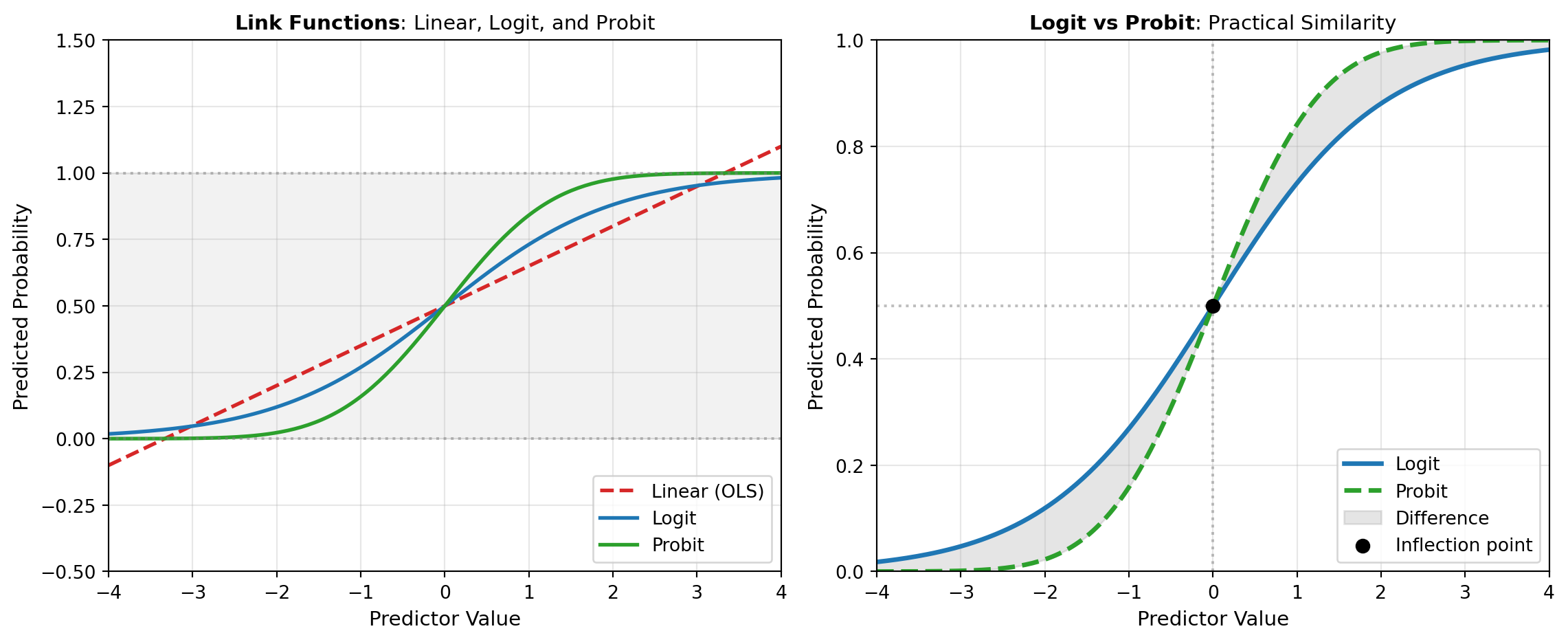
Logistic and Probit Models form the backbone of discrete choice analysis. These models address a critical limitation of ordinary least squares (OLS) regression when applied to binary or categorical outcomes: OLS produces unbounded predictions that can fall outside [0, 1], violates homoscedasticity assumptions, and assigns equal weight to all observations regardless of whether predictions are near 0.5 or extreme. Instead, logistic and probit models use nonlinear link functions that constrain predictions to the [0, 1] interval, making them theoretically sound and statistically efficient.
The logit model applies the logistic function to transform linear combinations of predictors into probabilities. It is implemented through scikit-learn, statsmodels, and scipy, and is widely used because the odds ratios have clear interpretations. When you have multiple unordered categories (e.g., choice of transportation mode: car, bus, train, bike), the multinomial logit model extends binary logit to the multi-category setting, estimating separate coefficients for each category relative to a baseline. This approach is popular in marketing and transportation research.
The probit model instead uses the cumulative normal distribution as its link function. Mathematically, it is equivalent to assuming the underlying utility difference follows a normal distribution. While probit and logit produce similar results in practice, probit is preferred in certain domains and offers computational advantages when modeling correlated choices (e.g., nested logit, mixed logit).
When choices have a natural ordering (e.g., satisfaction ratings: Very Dissatisfied, Dissatisfied, Neutral, Satisfied, Very Satisfied), ordered logit (and its counterpart, ordered probit) leverages this structure. These models assume a single latent continuous variable underlies the discrete outcomes, with threshold parameters determining boundaries between categories. This approach is more parsimonious and statistically efficient than multinomial logit when ordering is meaningful.
Implementation Context: Discrete choice models are estimated using maximum likelihood methods rather than OLS. Python libraries such as statsmodels and scikit-learn provide implementations. The choice of tool depends on the problem: use simple binary logit when predicting yes/no or two categories; use multinomial logit for unordered multi-category choices; and use ordered logit when categories are ranked.
Practical Applications: These models power recommendation systems (which product to buy), credit risk assessment (approve/deny/review), medical diagnosis (condition present/absent), and policy evaluation (did the program work?). Understanding the estimated coefficients reveals which factors drive choice, while predictions enable scenario analysis and optimization.
Tools
| Tool | Description |
|---|---|
| LOGIT_MODEL | Fits a binary logistic regression model to predict binary outcomes using maximum likelihood estimation. |
| MULTINOMIAL_LOGIT | Fits a multinomial logistic regression model for multi-category outcomes. |
| ORDERED_LOGIT | Fits an ordered logistic regression model for ordinal outcomes. |
| PROBIT_MODEL | Fits a binary probit regression model using maximum likelihood estimation. |